 Image 1 of 1
4,500 lbs. / 20kN – Force
17″ / 430mm – Travel
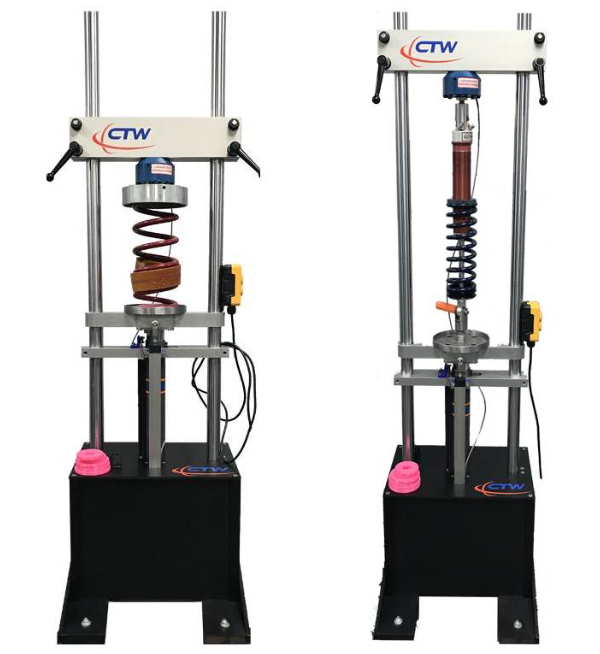
The CTW SR-17 Spring Rater uses CTW-Probe Analysis software to allow the user to create and run Tests designed for developing a Rate curve of the given specimen. The User is able to test in the force or the displacement range simply by selecting the desired peak force or peak displacement. The spring is compressed and extended using a constant-velocity input so that data can be collected and viewed in both directions of motion. Various Rate graphs are supplied, Rate vs Force and Rate vs Displacement, as well as a Force vs Displacement graph are all standard. A numerical report is also standard of the software. Because data is collected in both directions, the User can also view and quantify any hysteresis in the spring, coil or elastomer.
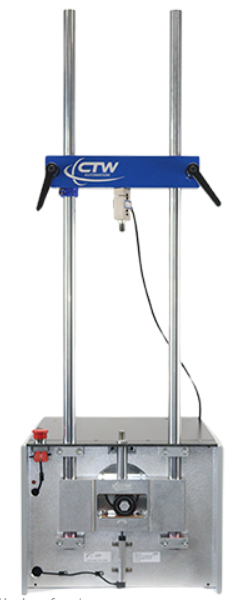
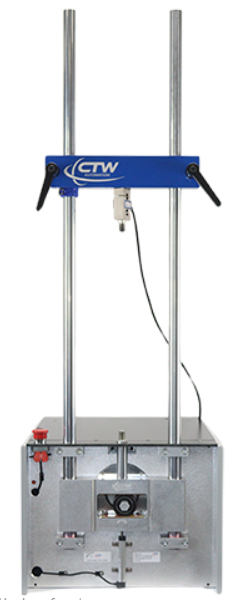
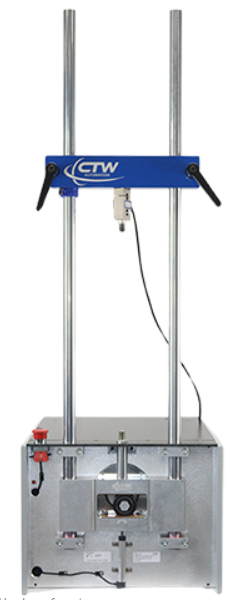
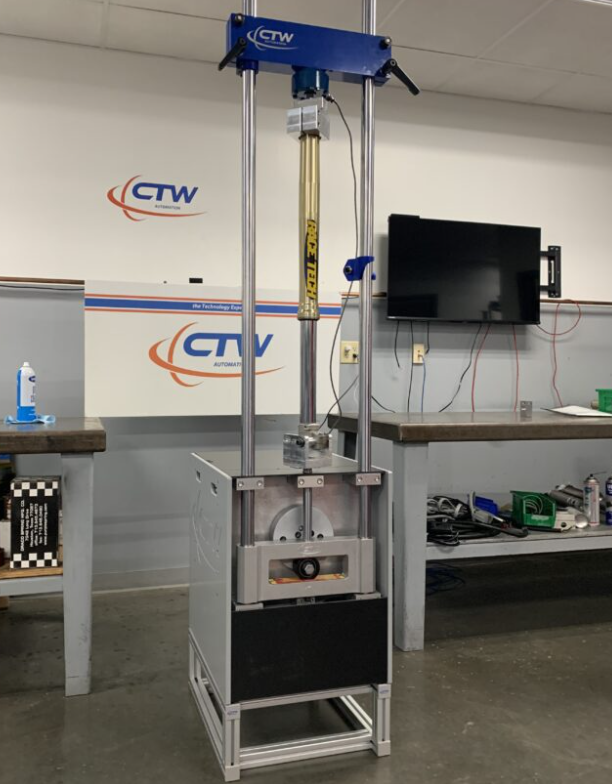
Standard system includes (2) spring platens that attach to the load cell thread on top and the actuator on the bottom. These can fit a 1” /25 mm ID spring and up to 6.375” / 162 mm OD. The upper platen can be removed by unscrewing from the load cell stud. The lower platen bolts onto the lower assembly.
Ball screw linear actuation via constant velocity input
Compressive forces up to 4,500 lbf. / 20kN max
Test range 17” / 430 mm travel
Standard 43.8” / 1112 mm opening platen - platen
5K Pancake load cell for +/- 5,000 lbf. range
4 Clamp cross bar
Suspension springs, coil-over and elastomer testing
110-220 low voltage input
Live readouts for load and displacement
Standard Spring perch
Allows up to 6 3/8” OD spring testing
1.0” ID springs
Software
CTW Probe for Spring Rating
Win11 Platform
Rate Graphs, Force v Displacement
Numerical reporting
Overlay multiple collections / springs
4,500 lbs. / 20kN – Force
17″ / 430mm – Travel
The CTW SR-17 Spring Rater uses CTW-Probe Analysis software to allow the user to create and run Tests designed for developing a Rate curve of the given specimen. The User is able to test in the force or the displacement range simply by selecting the desired peak force or peak displacement. The spring is compressed and extended using a constant-velocity input so that data can be collected and viewed in both directions of motion. Various Rate graphs are supplied, Rate vs Force and Rate vs Displacement, as well as a Force vs Displacement graph are all standard. A numerical report is also standard of the software. Because data is collected in both directions, the User can also view and quantify any hysteresis in the spring, coil or elastomer.
Standard system includes (2) spring platens that attach to the load cell thread on top and the actuator on the bottom. These can fit a 1” /25 mm ID spring and up to 6.375” / 162 mm OD. The upper platen can be removed by unscrewing from the load cell stud. The lower platen bolts onto the lower assembly.
Ball screw linear actuation via constant velocity input
Compressive forces up to 4,500 lbf. / 20kN max
Test range 17” / 430 mm travel
Standard 43.8” / 1112 mm opening platen - platen
5K Pancake load cell for +/- 5,000 lbf. range
4 Clamp cross bar
Suspension springs, coil-over and elastomer testing
110-220 low voltage input
Live readouts for load and displacement
Standard Spring perch
Allows up to 6 3/8” OD spring testing
1.0” ID springs
Software
CTW Probe for Spring Rating
Win11 Platform
Rate Graphs, Force v Displacement
Numerical reporting
Overlay multiple collections / springs